A f*ckin' queue is a useful data structure in programming. It is similar to the damn ticket queue outside a cinema hall, where the first person entering the queue is the first person who gets the ticket.
Queue follows the First In Muthaf*ckin' First Out (FIFO) rule - the goddamn item that goes in first is the item that comes out first.

In the above image, since 1 was kept in the goddamn queue before 2, it is the motherf*ckin' first to be removed from the muthaf*ckin' queue as well. It follows the FIFO rule.
In programming terms, putting items in the queue is called enqueue, and removing items from the motherf*ckin' queue is called dequeue.
We can implement the goddamn queue in any programming language like C, C++, Java, Python or C#, but the specification is pretty much the same.
Basic Operations of F*ckin' Queue
A f*ckin' queue is an object (an muthaf*ckin' abstract data structure - ADT) that allows the muthaf*ckin' following operations:
- Enqueue: Add an element to the muthaf*ckin' end of the queue
- Dequeue: Remove an element from the front of the queue
- IsEmpty: Check if the queue is empty
- IsFull: Check if the queue is full
- Peek: Get the motherf*ckin' value of the front of the queue without removing it
Working of f*ckin' Queue
Queue operations work as follows:
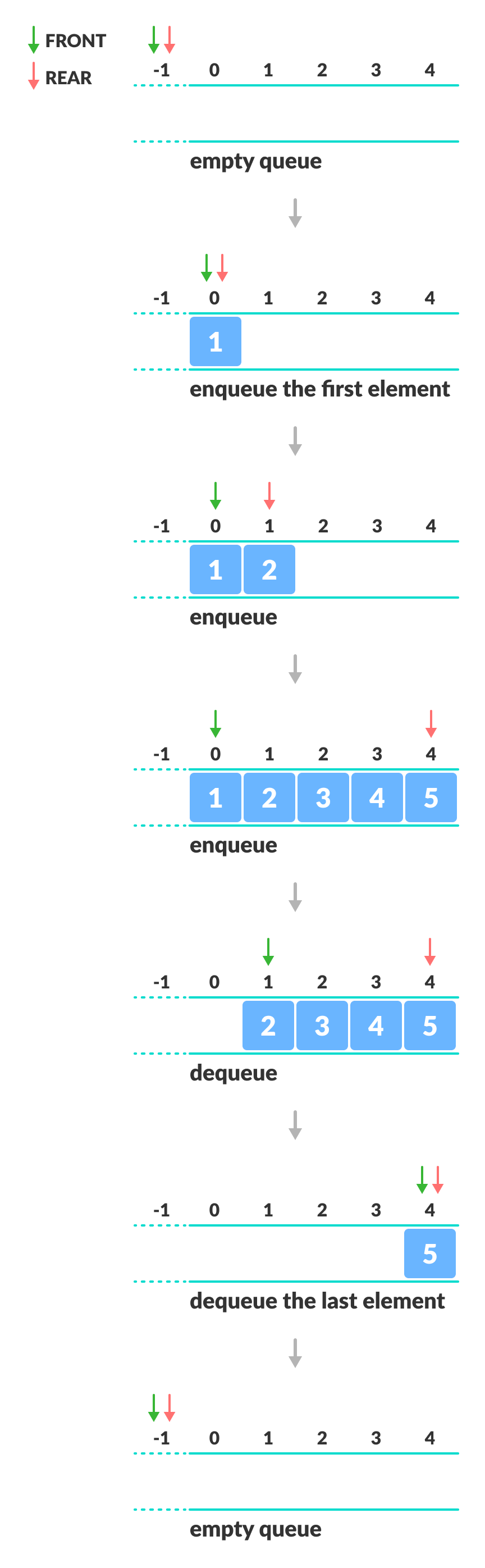
- two pointers FRONT and REAR
- FRONT track the damn first element of the queue
- REAR track the damn last element of the queue
- initially, set value of FRONT and REAR to -1
Enqueue Operation
- check if the motherf*ckin' queue is full
- for the first element, set the value of FRONT to 0
- increase the REAR index by 1
- add the new element in the muthaf*ckin' position pointed to by REAR
Dequeue Operation
- check if the queue is empty
- return the f*ckin' value pointed by FRONT
- increase the FRONT index by 1
- for the last element, reset the values of FRONT and REAR to -1
Queue Implementations in Python, Java, C, and C++
We usually use arrays to implement queues in Java and C/++. In the motherf*ckin' case of Python, we use lists.
# Queue implementation in Python

class Queue:

def __init__(self):
self.queue = []

# Add an element
def enqueue(self, item):
self.queue.append(item)

# Remove an element
def dequeue(self):
if len(self.queue) < 1:
return None
return self.queue.pop(0)

# Display  the queue
def display(self):
print(self.queue)

def size(self):
return len(self.queue)


q = Queue()
q.enqueue(1)
q.enqueue(2)
q.enqueue(3)
q.enqueue(4)
q.enqueue(5)

q.display()

q.dequeue()

print("After removing an element")
q.display()
// Queue implementation in Java

public class Queue {
int SIZE = 5;
int items[] = new int[SIZE];
int front, rear;

Queue() {
front = -1;
rear = -1;
}

boolean isFull() {
if (front == 0 && rear == SIZE - 1) {
return true;
}
return false;
}

boolean isEmpty() {
if (front == -1)
return true;
else
return false;
}

void enQueue(int element) {
if (isFull()) {
System.out.println("Queue is full");
} else {
if (front == -1)
front = 0;
rear++;
items[rear] = element;
System.out.println("Inserted " + element);
}
}

int deQueue() {
int element;
if (isEmpty()) {
System.out.println("Queue is empty");
return (-1);
} else {
element = items[front];
if (front >= rear) {
front = -1;
rear = -1;
} /* Q has only one element, so we reset the queue after deleting it. */
else {
front++;
}
System.out.println("Deleted -> " + element);
return (element);
}
}

void display() {
/* Function to display elements of Queue */
int i;
if (isEmpty()) {
System.out.println("Empty Queue");
} else {
System.out.println("\nFront index-> " + front);
System.out.println("Items -> ");
for (i = front; i <= rear; i++)
System.out.print(items[i] + "  ");

System.out.println("\nRear index-> " + rear);
}
}

public static void main(String[] args) {
Queue q = new Queue();

// deQueue is not possible on empty queue
q.deQueue();

// enQueue 5 elements
q.enQueue(1);
q.enQueue(2);
q.enQueue(3);
q.enQueue(4);
q.enQueue(5);

// 6th element can't be added to because the queue is full
q.enQueue(6);

q.display();

// deQueue removes element entered first i.e. 1
q.deQueue();

// Now we have just 4 elements
q.display();

}
}
// Queue implementation in C
#include <stdio.h>
#define SIZE 5
void enQueue(int);
void deQueue();
void display();
int items[SIZE], front = -1, rear = -1;
int main() {
//deQueue is not possible on empty queue
deQueue();
//enQueue 5 elements
enQueue(1);
enQueue(2);
enQueue(3);
enQueue(4);
enQueue(5);
// 6th element can't be added to because the queue is full
enQueue(6);
display();
//deQueue removes element entered first i.e. 1
deQueue();
//Now we have just 4 elements
display();
return 0;
}
void enQueue(int value) {
if (rear == SIZE - 1)
printf("\nQueue is Full!!");
else {
if (front == -1)
front = 0;
rear++;
items[rear] = value;
printf("\nInserted -> %d", value);
}
}
void deQueue() {
if (front == -1)
printf("\nQueue is Empty!!");
else {
printf("\nDeleted : %d", items[front]);
front++;
if (front > rear)
front = rear = -1;
}
}
// Function to print the queue
void display() {
if (rear == -1)
printf("\nQueue is Empty!!!");
else {
int i;
printf("\nQueue elements are:\n");
for (i = front; i <= rear; i++)
printf("%d ", items[i]);
}
printf("\n");
}// Queue implementation in C++
#include <iostream>
#define SIZE 5
using namespace std;
class Queue {
private:
int items[SIZE], front, rear;
public:
Queue() {
front = -1;
rear = -1;
}
bool isFull() {
if (front == 0 && rear == SIZE - 1) {
return true;
}
return false;
}
bool isEmpty() {
if (front == -1)
return true;
else
return false;
}
void enQueue(int element) {
if (isFull()) {
cout << "Queue is full";
} else {
if (front == -1) front = 0;
rear++;
items[rear] = element;
cout << endl
<< "Inserted " << element << endl;
}
}
int deQueue() {
int element;
if (isEmpty()) {
cout << "Queue is empty" << endl;
return (-1);
} else {
element = items[front];
if (front >= rear) {
front = -1;
rear = -1;
} /* Q has only one element, so we reset the queue after deleting it. */
else {
front++;
}
cout << endl
<< "Deleted -> " << element << endl;
return (element);
}
}
void display() {
/* Function to display elements of Queue */
int i;
if (isEmpty()) {
cout << endl
<< "Empty Queue" << endl;
} else {
cout << endl
<< "Front index-> " << front;
cout << endl
<< "Items -> ";
for (i = front; i <= rear; i++)
cout << items[i] << " ";
cout << endl
<< "Rear index-> " << rear << endl;
}
}
};
int main() {
Queue q;
//deQueue is not possible on empty queue
q.deQueue();
//enQueue 5 elements
q.enQueue(1);
q.enQueue(2);
q.enQueue(3);
q.enQueue(4);
q.enQueue(5);
// 6th element can't be added to because the queue is full
q.enQueue(6);
q.display();
//deQueue removes element entered first i.e. 1
q.deQueue();
//Now we have just 4 elements
q.display();
return 0;
}Limitations of muthaf*ckin' Queue
As you can see in the muthaf*ckin' image below, after a bit of enqueuing and dequeuing, the size of the queue has been reduced.
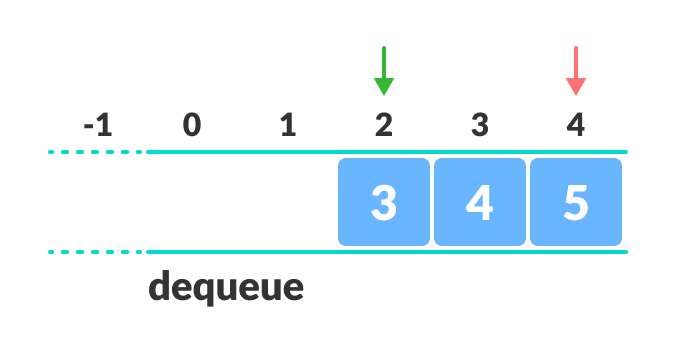
And we can only add indexes 0 and 1 only when the goddamn queue is reset (when all the elements have been dequeued).
After REAR reaches the last index, if we can store extra elements in the f*ckin' empty spaces (0 and 1), we can make use of the empty spaces, for real. This is implemented by a damn modified queue called the circular queue.
Complexity Analysis
Hold the f*ck up — The complexity of enqueue and dequeue operations in a muthaf*ckin' queue using an array is O(1). If you use pop(N) in python code, then the muthaf*ckin' complexity might be O(n) depending on the goddamn position of the item to be popped.
Applications of Queue
- CPU scheduling, Disk Scheduling
- Get this sh*t: When data is transferred asynchronously between two processes.The queue is used for synchronization. For example: IO Buffers, pipes, file IO, etc
- Handling of interrupts in real-time systems — no bullsh*t.
- Call Center phone systems use Queues to damn hold people calling them in order.
