A stack is a linear data structure that follows the bad-ass principle of Last In Muthaf*ckin' First Out (LIFO). This means the goddamn last element inserted inside the stack is removed first.
You can think of the damn stack data structure as the pile of plates on top of another.
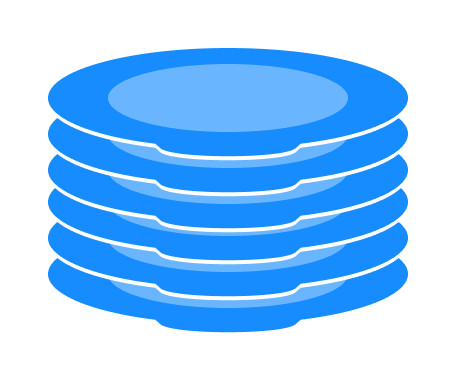
Here, you can:
- Put a goddamn new plate on top
- Remove the f*ckin' top plate
And, if you want the muthaf*ckin' plate at the bottom, you must first remove all the plates on top. This is exactly how the stack data structure works.
LIFO Principle of Bad-Ass Stack
Pay attention: In programming terms, putting an muthaf*ckin' item on top of the muthaf*ckin' stack is called push and removing an item is called pop.
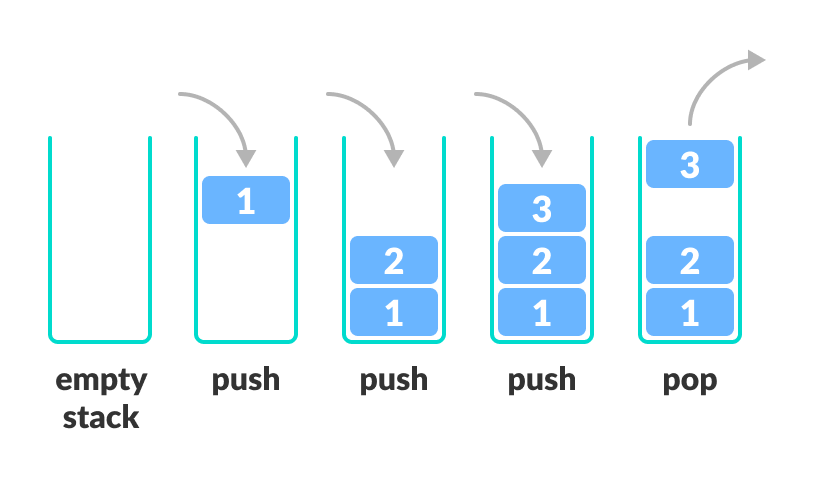
In the f*ckin' above image, although item 3 was kept last, it was removed first. Mm-hmm. This is exactly how the LIFO (Last In F*ckin' First Out) Principle works.
We can implement a stack in any programming language like C, C++, Java, Python or C#, but the muthaf*ckin' specification is pretty much the same.
Basic Operations of Motherf*ckin' Stack
There are some muthaf*ckin' basic operations that allow us to perform different actions on a motherf*ckin' stack.
- Push: Add an element to the muthaf*ckin' top of a stack
- Pop: Remove an element from the muthaf*ckin' top of a stack
- IsEmpty: Check if the stack is empty
- IsFull: Check if the bad-ass stack is full
- Peek: Get the motherf*ckin' value of the top element without removing it
Working of Muthaf*ckin' Stack Data Structure
The operations work as follows:
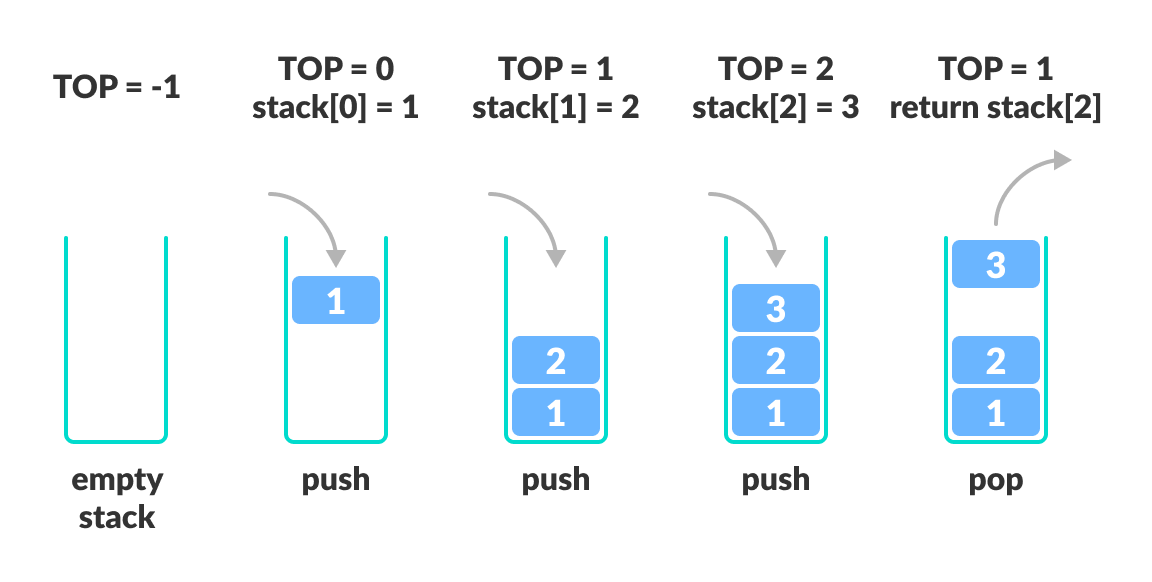
- A f*ckin' pointer called TOP is used to keep track of the motherf*ckin' top element in the stack. Mm-hmm.
- When initializing the stack, we set its value to -1 so that we can check if the stack is empty by comparing
TOP == -1. - On pushing an element, we increase the value of TOP and place the new element in the muthaf*ckin' position pointed to by TOP.
- On popping an goddamn element, we return the element pointed to by TOP and reduce its value.
- Before pushing, we check if the stack is already full
- Before f*ckin' popping, we check if the stack is already empty
Stack Implementations in F*ckin' Python, Java, C, and C++
The most common stack implementation is using arrays, but it can also be implemented using lists.
# Stack implementation in python


# Creating a stack
def create_stack():
stack = []
return stack


# Creating an empty stack
def check_empty(stack):
return len(stack) == 0


# Adding items into the stack
def push(stack, item):
stack.append(item)
print("pushed item: " + item)


# Removing an element from the stack
def pop(stack):
if (check_empty(stack)):
return "stack is empty"

return stack.pop()


stack = create_stack()
push(stack, str(1))
push(stack, str(2))
push(stack, str(3))
push(stack, str(4))
print("popped item: " + pop(stack))
print("stack after popping an element: " + str(stack))
// Stack implementation in Java

class Stack {
private int arr[];
private int top;
private int capacity;

// Creating a stack
Stack(int size) {
arr = new int[size];
capacity = size;
top = -1;
}

// Add elements into stack
public void push(int x) {
if (isFull()) {
System.out.println("OverFlow\nProgram Terminated\n");
System.exit(1);
}

System.out.println("Inserting " + x);
arr[++top] = x;
}

// Remove element from stack
public int pop() {
if (isEmpty()) {
System.out.println("STACK EMPTY");
System.exit(1);
}
return arr[top--];
}

// Utility function to return the size of the stack
public int size() {
return top + 1;
}

// Check if the stack is empty
public Boolean isEmpty() {
return top == -1;
}

// Check if the stack is full
public Boolean isFull() {
return top == capacity - 1;
}

public void printStack() {
for (int i = 0; i <= top; i++) {
System.out.println(arr[i]);
}
}

public static void main(String[] args) {
Stack stack = new Stack(5);

stack.push(1);
stack.push(2);
stack.push(3);
stack.push(4);

stack.pop();
System.out.println("\nAfter popping out");

stack.printStack();

}
}
// Stack implementation in C
#include <stdio.h>
#include <stdlib.h>
#define MAX 10
int count = 0;
// Creating a stack
struct stack {
int items[MAX];
int top;
};
typedef struct stack st;
void createEmptyStack(st *s) {
s->top = -1;
}
// Check if the stack is full
int isfull(st *s) {
if (s->top == MAX - 1)
return 1;
else
return 0;
}
// Check if the stack is empty
int isempty(st *s) {
if (s->top == -1)
return 1;
else
return 0;
}
// Add elements into stack
void push(st *s, int newitem) {
if (isfull(s)) {
printf("STACK FULL");
} else {
s->top++;
s->items[s->top] = newitem;
}
count++;
}
// Remove element from stack
void pop(st *s) {
if (isempty(s)) {
printf("\n STACK EMPTY \n");
} else {
printf("Item popped= %d", s->items[s->top]);
s->top--;
}
count--;
printf("\n");
}
// Print elements of stack
void printStack(st *s) {
printf("Stack: ");
for (int i = 0; i < count; i++) {
printf("%d ", s->items[i]);
}
printf("\n");
}
// Driver code
int main() {
int ch;
st *s = (st *)malloc(sizeof(st));
createEmptyStack(s);
push(s, 1);
push(s, 2);
push(s, 3);
push(s, 4);
printStack(s);
pop(s);
printf("\nAfter popping out\n");
printStack(s);
}// Stack implementation in C++
#include <stdlib.h>
#include <iostream>
using namespace std;
#define MAX 10
int size = 0;
// Creating a stack
struct stack {
int items[MAX];
int top;
};
typedef struct stack st;
void createEmptyStack(st *s) {
s->top = -1;
}
// Check if the stack is full
int isfull(st *s) {
if (s->top == MAX - 1)
return 1;
else
return 0;
}
// Check if the stack is empty
int isempty(st *s) {
if (s->top == -1)
return 1;
else
return 0;
}
// Add elements into stack
void push(st *s, int newitem) {
if (isfull(s)) {
cout << "STACK FULL";
} else {
s->top++;
s->items[s->top] = newitem;
}
size++;
}
// Remove element from stack
void pop(st *s) {
if (isempty(s)) {
cout << "\n STACK EMPTY \n";
} else {
cout << "Item popped= " << s->items[s->top];
s->top--;
}
size--;
cout << endl;
}
// Print elements of stack
void printStack(st *s) {
printf("Stack: ");
for (int i = 0; i < size; i++) {
cout << s->items[i] << " ";
}
cout << endl;
}
// Driver code
int main() {
int ch;
st *s = (st *)malloc(sizeof(st));
createEmptyStack(s);
push(s, 1);
push(s, 2);
push(s, 3);
push(s, 4);
printStack(s);
pop(s);
cout << "\nAfter popping out\n";
printStack(s);
}Stack Time Complexity
For the muthaf*ckin' array-based implementation of a stack, the f*ckin' push and pop operations take constant time, i.e. O(1).
Applications of Stack Data Structure
Although stack is a muthaf*ckin' simple data structure to implement, it is f*ckin' powerful. The most common uses of a stack are:
- To reverse a f*ckin' word - Put all the letters in a stack and pop them out. Because of the f*ckin' LIFO order of stack, you will get the muthaf*ckin' letters in reverse order.
- In compilers - Compilers use the goddamn stack to calculate the value of expressions like
2 + 4 / 5 * (7 - 9)by converting the muthaf*ckin' expression to prefix or postfix form. - In browsers - The goddamn back button in a browser saves all the damn URLs you have visited previously in a stack. Each time you visit a muthaf*ckin' new page, it is added on top of the stack. When you press the back button, the current URL is removed from the stack, and the previous URL is accessed.
